Between Two Americans
About The Book

Between Two Americans
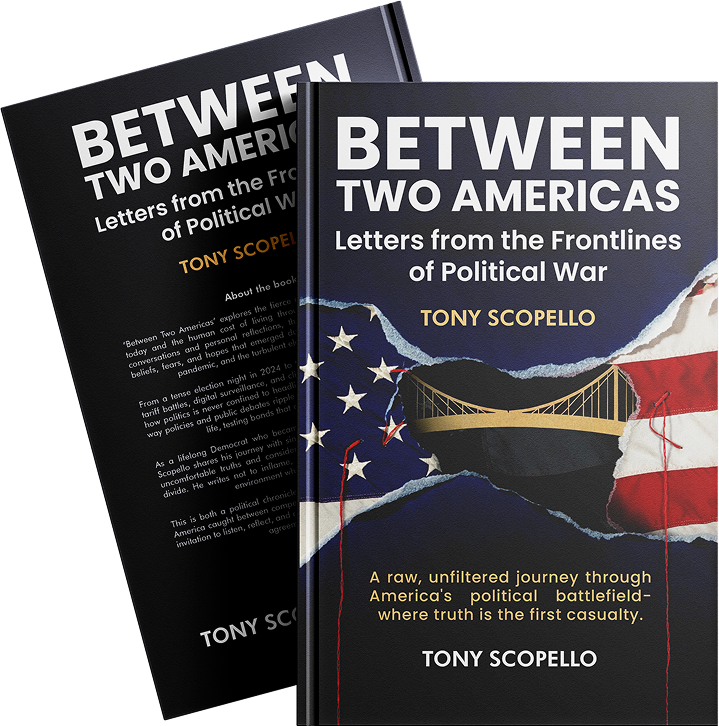
Between Two Americas: Letters from the Frontlines of Political War
Written under the name Tony Scopello
Between Two Americas is a raw, real-time record of a country talking past itself.
Written in the immediate aftermath of the 2024 election, the book captures unfiltered conversations as events unfold: late-night phone calls, heated text exchanges, painful arguments, uneasy reconciliations, and moments where language itself seems to fail. Friends witness the same headlines
yet inhabit entirely different realities. Facts no longer overlap. Trust collapses. Motives are questioned. Relationships strain under the weight of certainty.
This is not an analysis written after the dust settles. It is dialogue written while emotions are still burning and consequences are still forming. The author does not sanitize the exchanges or smooth their edges. Disagreement is messy. Anger is present. Resolution is not guaranteed.
The book documents a nation mid-argument-red and blue staring across an ever-widening chasm-asking whether dialogue can survive when reality itself is contested. It is not a call to pick sides, but a record of what happens when sides refuse to hear one another.
Coming Soon
Why Read It?
Between Two Americans
In a time when conversation has become dangerous, these pages preserve the sound of people still trying.
Dedicated to Charlie Kirk, whose voice-uncompromising, fearless, and relentlessly engaged-reminded the author that speaking across divides is not surrender, but courage.
Get in Touch
Testimonials
See Our Real Success Stories
Reviewed in the United States on February 17, 2025
“Reading this felt like being inside conversations I’ve actually had: tense, real, and unresolved.”
Reviewed in the United States on February 17, 2025
“It captures how divided America sounds when no one is pretending anymore.”
Reviewed in the United States on February 17, 2025
“Uncomfortable, honest, and impossible to dismiss. This is what polarization really looks like.”
Chapters
Between Two Americans
Chapter 1
A Week (And More) Later
The phone didn’t ring. It screamed. 5:47 a.m. November 6th. It launched itself off the nightstand, hit the floor, and kept vibrating
Chapter 2
The Tariff Wars
It had been 8 months since the election, and the world was unrecognizable. On July 27th, 2025, New York was facing a heat wave,
Chapter 3
Digital Chains and Broken Bonds
The victory lasted about two weeks. It was late April 2025. The glory celebrations following the election were over, the mayor’s office was already
Chapter 4
The Cost of Division
The unrelenting heat of September was felt not only outside but also in the political arena. Throughout the season, corruption probes had been gaining
Chapter 5
Flames and Revelations
January 2025 brought more than just a new year—it brought fire, devastation, and the kind of revelations that made everything crystal clear about who was
Chapter 6
The Kennedy Crucible
September arrived with the kind of heat that makes you question whether summer will ever end, but the political temperature was even more scorching. Robert
Chapter 7
Climate Wars
October brought the kind of crisp air that reminded you winter was coming, but my conversations with Lucas were heating up in ways I hadn’t
Chapter 8
The Kennedy Crucible—Round Two
November arrived with the kind of anticipation that makes your stomach churn. Robert F. Kennedy Jr.’s second round of confirmation hearings was scheduled, and after the
Chapter 9
Charlie Kirk
I was sitting at the kitchen table with the news scrolling across my phone, the kind of morning where you don’t expect anything more dramatic
Chapter 10
Intrigue
The world didn’t slow down after Charlie was killed; it sped up. Every screen, every network, every feed turned into a live autopsy of the
Chapter 11
The Church Betrayal
The noise of the world faded, but the ache remained. After weeks of headlines, theories and political fallout, I found myself drawn back to something
Chapter 12
In His Own Words
The morning after Charlie’s death, I sat at my kitchen table scrolling through videos of him speaking at college campuses, doing interviews, and debating critics
Chapter 13
The Great Awakening
The nights had grown quieter, but Tony couldn’t remember the last time he’d felt peace. The world outside hummed with static—not from traffic or sirens,
Chapter 14
The Last Single
The night had been unnaturally still, the kind of quiet that presses against your skin like a warning. Tony sat at the desk with a
Prologue
Prologue
The phone wouldn’t stop buzzing. November 6th, 2024. Johnny from Nashville sounded like someone had died. Sara in Staten Island couldn’t stop crying. Tommy in Dallas could barely speak. Gloria sent screenshots of news articles. Max in Florida was convinced it was the end of the world.
A week later Barry asked how I felt now that we were driving off a cliff. A few weeks after that, Howie called from Hawaii to see if I was still “100% MAGA” now that reality had set in.
Last year I wrote a book hoping to bridge the growing chasm between red and blue America. I documented my own journey from lifelong Democrat to reluctant Trump supporter, thinking honest conversations might create understanding.
Boy was I wrong.
The country split further. The arguments grew nastier. Everyone picked a side and decided the other was evil. Reading that first book now, I see how it must have landed for people like Barry, not as dialogue, but as a conversion story. I wrote as if I had moved from darkness to light, every conversation ending with me vindicated. That wasn’t bridge-building. That was advocacy wearing better packaging.
Yet we kept talking anyway. Most of us, at least.
Lori, whom I’ve known forever, we dated as teenagers, ended our lifelong friendship with “Fuck off, Tony.” She couldn’t stand that I didn’t share her intense hatred of Trump. When she texted again a week later, with no apology or regret, acting as if nothing had happened, I blocked her. I didn’t recognize her anymore.
My first book dropped three days before the 2024 election: terrible timing; everyone had already made up their minds. The publisher screwed me, felt like a setup from the start.
This time is different. Trump won Big. Within a week, Mexico deployed 10,000 troops to the border, Hamas released hostages, and Canada began securing theirs. Countries that ignored Biden suddenly paid attention.
Barry sees fascism. I see momentum.
“So, my brother, as we watch our country go over a cliff, do you still think we’re on the right track?” he asked a week after the election.
I laughed. “I thought you’d be admitting how wrong you were.”
Same old Barry. Same old arguments. But the stakes felt higher now. The anger deeper. The gap between our realities wider than ever.
We weren’t just disagreeing about solutions anymore. We were living in different versions of the truth—Barry with MSNBC and CNN, me with independent journalists and Substack. The media had turned us into residents of separate countries.
Amid that frenzy, one voice cut through like a thunderclap: Charlie Kirk on a Turning Point USA livestream. “This isn’t just about an election win,” he declared. “It’s about reclaiming the freedom that’s been slipping away.” His words hit hard, exposing illusions on both sides and demanding we fight for real liberty without complacency.
Charlie’s influence only grew after his tragic assassination on September 10, 2025, at Utah Valley University. The sniper’s bullet didn’t silence him, it amplified his warnings about cultural Marxism, free speech, and the toxic divisions that ultimately claimed his life. His legacy became a call to bridge divides without compromising truth. Dedicating this book to him feels like carrying that torch forward.
The dialogues in these pages are real: messy, painful, and ongoing. I changed some names, but the words and emotions are as they happened. Barry believes I’ve been brainwashed by conspiracy theories. I believe he’s been conditioned by corporate media. We both love this country. We just fear for it in completely different ways.
Perhaps that’s the real crisis: not our disagreements, but that we can no longer agree on basic facts.
Gloria was the one who first forced me to question my own certainties. She got so angry after one flippant remark about Trump that she didn’t speak to me for eight months. When we finally resumed, she didn’t win me over with shouting; she simply showed me facts I had never seen.
That’s what these conversations are really about. Not winning. Not converting. Just trying, however imperfectly, to see the world through the other person’s eyes.
We keep talking even when it hurts, because the alternative is too frightening to accept. As long as the phone still rings, there’s a chance we might find our way forward. Even when “forward together” feels impossible.